
Executive Support is a System
By Brett Phillips, MPH | October 7, 2026
When an executive who is overwhelmed or looking to perform at a higher level is presented with “better executive support” as a pathway to their goals, the suggestion is oftentimes met with an eye roll.
After all, many executives already have support. They work with an Executive Assistant who takes things off their plate. They hired a Chief of Staff after hearing colleagues describe the benefits of having a strategic right hand.
And yet, the executive still does not feel like they are performing as well as they could be.
The truth is that having an Assistant or Chief of Staff and having a high-performing support system are not the same thing.
The right question for executives is not simply whether they have people occupying support roles, it is whether they have created the right conditions to activate the full value of the executive support system.
In most organizations, the honest answer is no. Not because the executive doesn’t care or because the support team lacks talent, but because the demands of the executive’s day-to-day continually push the work of building and maintaining an effective support system to the bottom of the priority list.
This points to a significant opportunity: many executives have untapped value within their existing support teams. For the sake of executive sanity and performance, we need to unlock it.
The Three Components of a Strategic Support System
For executive support to reach its full potential, we need to break the system down to its core components, strengthen each, then reconnect them into a cohesive whole.
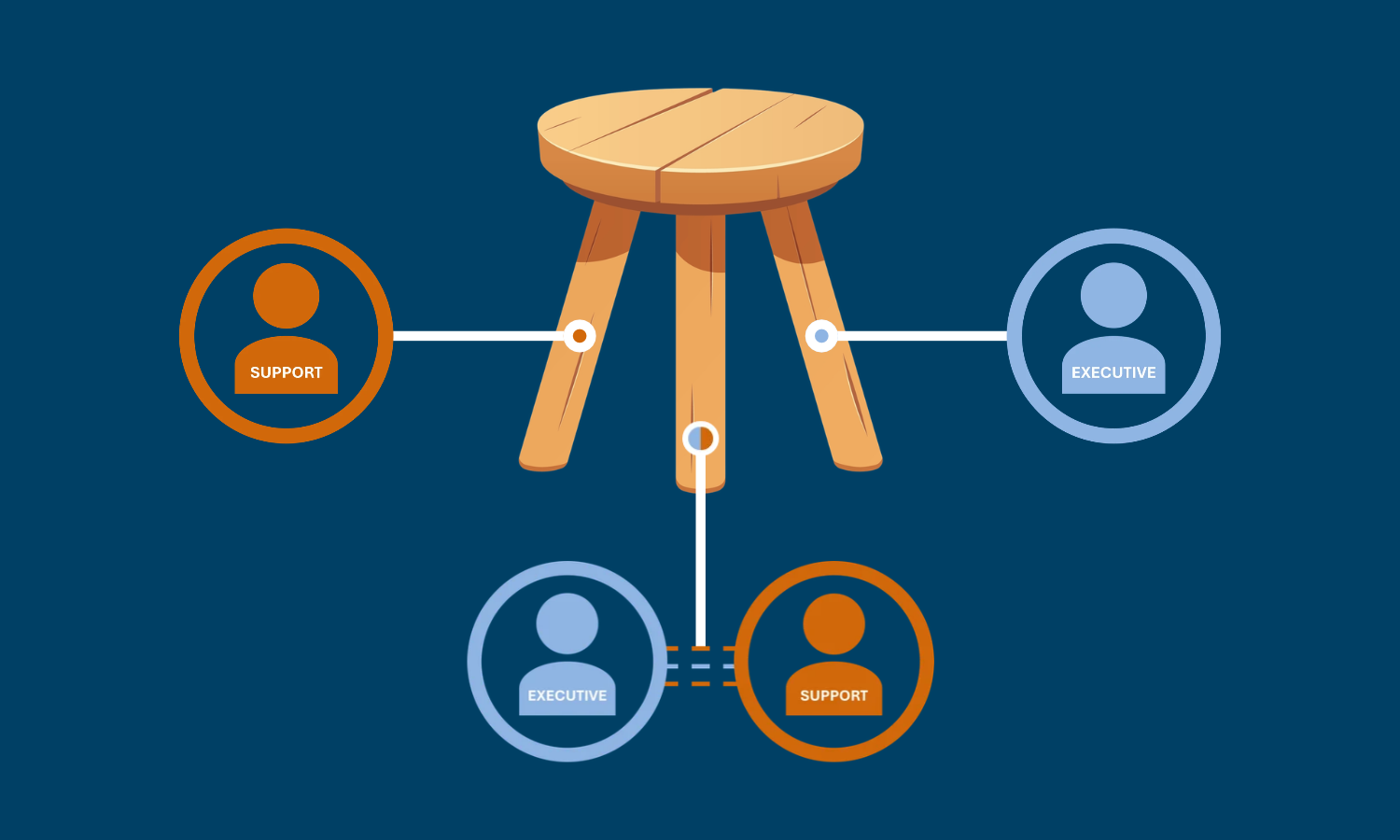
A high-performing and strategic support system rests on three mutually dependent pillars. Executive Clarity defines the type of support the executive actually needs. Support Proficiency equips the Assistant or Chief of Staff with the skills to provide it. And Operational Alignment establishes processes that ensure consistent, on-time deployment of that support.

Like three legs of a stool, each pillar serves a purpose. No single leg (or combination of two) can create a stable system in isolation. If any one is missing, the system crumbles.
The Strategic Support System framework makes one point especially clear: executives cannot outsource the development of their own support system. If they want to experience the full value of support, executives must take part in their own rescue.
Start with Executive Clarity
Imagine hiring an in-home chef without telling them what kind of food you like or what types of meals you’re looking for. I bet that there’d be a lot of guesswork and frustration in the kitchen and a lot of complaining at the dinner table as a result.
In order for a task to be done well, a request needs to be clear and specific.
It sounds simple, but this rule applies to a fundamental issue plaguing executives and their support teams. Executives jump right into the work after spending little-to-no time scoping a job role with a clear and realistic set of responsibilities for their Assistant or Chief of Staff.
Instead, requests are sent on an ad hoc basis for calendar assistance, stakeholder engagement, project management, event planning, administrative support, travel planning, meeting prep, speechwriting – the list goes on. The support professional is left playing whack-a-mole with the request of the day, never knowing reliably what duty will surface next.
When everything falls within the scope of a role, nothing is meaningfully prioritized. An Assistant or Chief of Staff cannot be effective when spreading their attention across an unpredictable and overwhelming mix of duties without a clear understanding of what matters most. They become a jack of all trades, master of none – when their executive just needs them to be a master of some.
The consequences of watered-down roles and responsibilities rebound back to the executive. Instead of getting great support in five areas, they get mediocre support in ten. They see inconsistency in the quality of the work, slow turnaround time, and a lack of anticipation from their support team. And despite asking for a lot, the executive feels like they are getting very little in return.
Invest in Support Proficiency
Clarity is necessary, but it is not sufficient. Once a support team member understands what the executive needs, they must possess the skills, judgment, and confidence to provide it.
Unfortunately, executive support professionals rarely receive formal training.
Consider how a traditional, non-support new hire is developed. They typically join a department alongside people performing similar work, reporting to a supervisor who has an in-depth understanding of the job role. That supervisor may have previously held the same position and is familiar with its day-to-day responsibilities and established best practices. The new hire has someone who can demonstrate the work, define what good performance looks like, and provide informed feedback.
That infrastructure rarely exists in the world of executive support.
An Executive Assistant or Chief of Staff may be a department of one, reporting directly to their executive. And yes, the executive may be qualified to define the type of support they need, but they are likely not equipped to teach someone how to provide it. Most executives have never worked in an executive support role, are not familiar with support best practices, and have little-to-no bandwidth to build a comprehensive training program.
This training gap can easily be mistaken for a talent problem. The support team is forced to build the plane as they fly it, piecing together their own methods through observation and experience - but mostly through trial and error. The executive may question why their Assistant or Chief of Staff is struggling to meet expectations and still requires so much direction and oversight.
In reality, both are experiencing the consequences of the same missing infrastructure: expectations may have been communicated, but the support team was never properly taught how to fulfill them. In many instances, the executive concludes that completing the work themselves is faster than delegating it and the support team is left in limbo, waiting for training and instruction that will likely never come.
Establish and Maintain Operational Alignment
An executive can clearly articulate what they need, their support team can develop the capabilities to deliver it, and the system can still fall short.
Think about a band with a rockstar singer and a killer guitarist. Each is talented, but to make great music they need the right songs, time to rehearse, and a shared sense of how to play together. The same is true of an executive and their support team.
Even with stellar individual performance from both contributors, support will be inconsistent if the team does not define a strategy for how they will work together. Which meetings need support. When documents will be delivered. When the team will meet to discuss projects, tasks, requests, and messages.
When the Operational Alignment pillar is weak, delegation becomes inconsistent, check-in meetings are cancelled, responsibilities blur, and work is completed late (or falls through the cracks entirely). In this environment, skill is not the missing ingredient; coordination is.
The power of the support system does not come from either person independently. It emerges from the partnership between them: the consistent exchange of information, clear ownership of responsibilities, and predictable operating rhythms that allow both sides to remain aligned and anticipate what comes next.
Operational Alignment is what makes the whole of the system greater than the sum of its parts.
The Strategic Support System in Practice
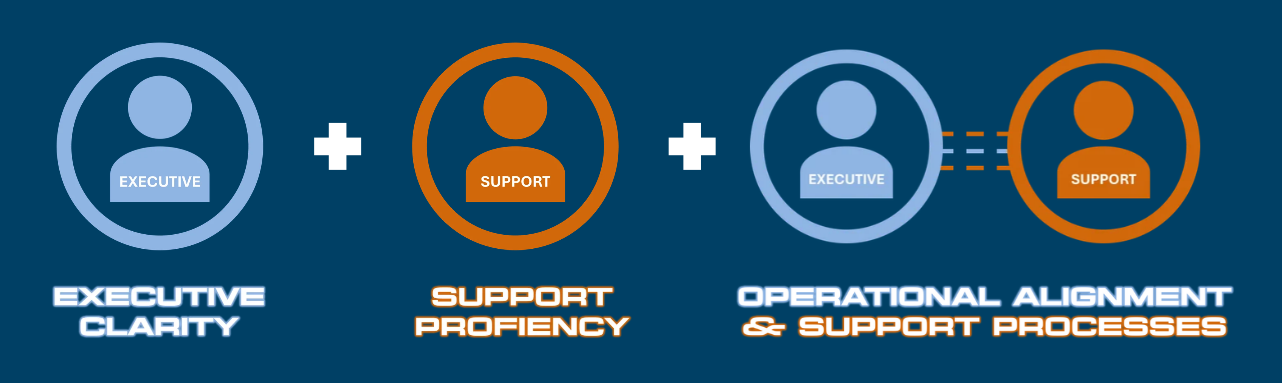
So, what does this look like in practice?
Consider an executive who regularly leaves meetings with tasks to address or decisions to implement. Their days are crowded, meetings run back-to-back, and important follow-up items are increasingly lost in the shuffle.
They hire an assistant, expecting that another set of hands will naturally improve their follow-through. But because the executive is already overloaded, the assistant jumps into the work without a clear understanding of what they are expected to own or how the partnership should operate.
The executive may forward meeting notes or mention outstanding tasks (when they remember). The assistant tracks what they can and sends occasional reminders but lacks a complete picture of the executive’s commitments. Some items are completed, others are delayed, and some continue to fall through the cracks. The executive wonders why adding support has produced little improvement.
A Strategic Support System approaches the same situation differently.
During onboarding, the executive identifies meeting follow-up and task management as a high-impact area of support. They explain where commitments are currently being lost and define the responsibilities that the assistant will own. The assistant understands that this work should be prioritized. Executive Clarity is solidified.
With priorities now clearly defined, the assistant receives targeted training on how to turn vague action items into clearly assigned tasks with deadlines, translate decisions into meaningful follow-through, and assess whether meetings are reaching their intended goals. They develop the judgment to intercept tasks that do not require the executive’s involvement, deliver well-timed reminders, and recognize patterns of meeting waste before they become recurring problems. Support Proficiency is established.
To ensure consistent execution, the executive and assistant build a repeatable follow-up process together. They implement an AI notetaking tool, maintain a shared notebook and task tracker, and review unresolved commitments during a weekly check-in meeting. Operational Alignment is strong.
The executive is no longer solely responsible for remembering, organizing, and advancing every commitment that emerges from a meeting. And the assistant can anticipate what happens next because the priority is clear, the necessary skills have been developed, and a dependable process connects their work to the executive. Tasks stop disappearing, decisions lead to action, and follow-through becomes more consistent.
What appears to be stronger individual performance is actually the product of a stronger support system.
Everybody Wins
Too many efforts to improve executive performance begin and end with the executive. They ask the leader to manage time more carefully, delegate more effectively, communicate more clearly, or become more resilient.
The reverse approach is equally futile. Upskilling an Assistant or Chief of Staff in isolation accomplishes little if the executive is not engaged in defining what support they need or in establishing how the partnership will operate. Great training cannot compensate for unclear priorities and a half-baked operating structure.
The Strategic Support System model offers a different starting point. Rather than assigning blame to either the executive or the support team, it identifies gaps in clarity, capability, and coordination and strengthens how existing members of a team work individually and together.
The value within the support system is there – it’s on us to unlock it.
Follow EES on LinkedIn, TikTok, and Instagram for insights on executive efficiency, support team effectiveness, and the future of performance enhancement in the C-Suite.
