
By Brett Phillips, MPH | November 4, 2026
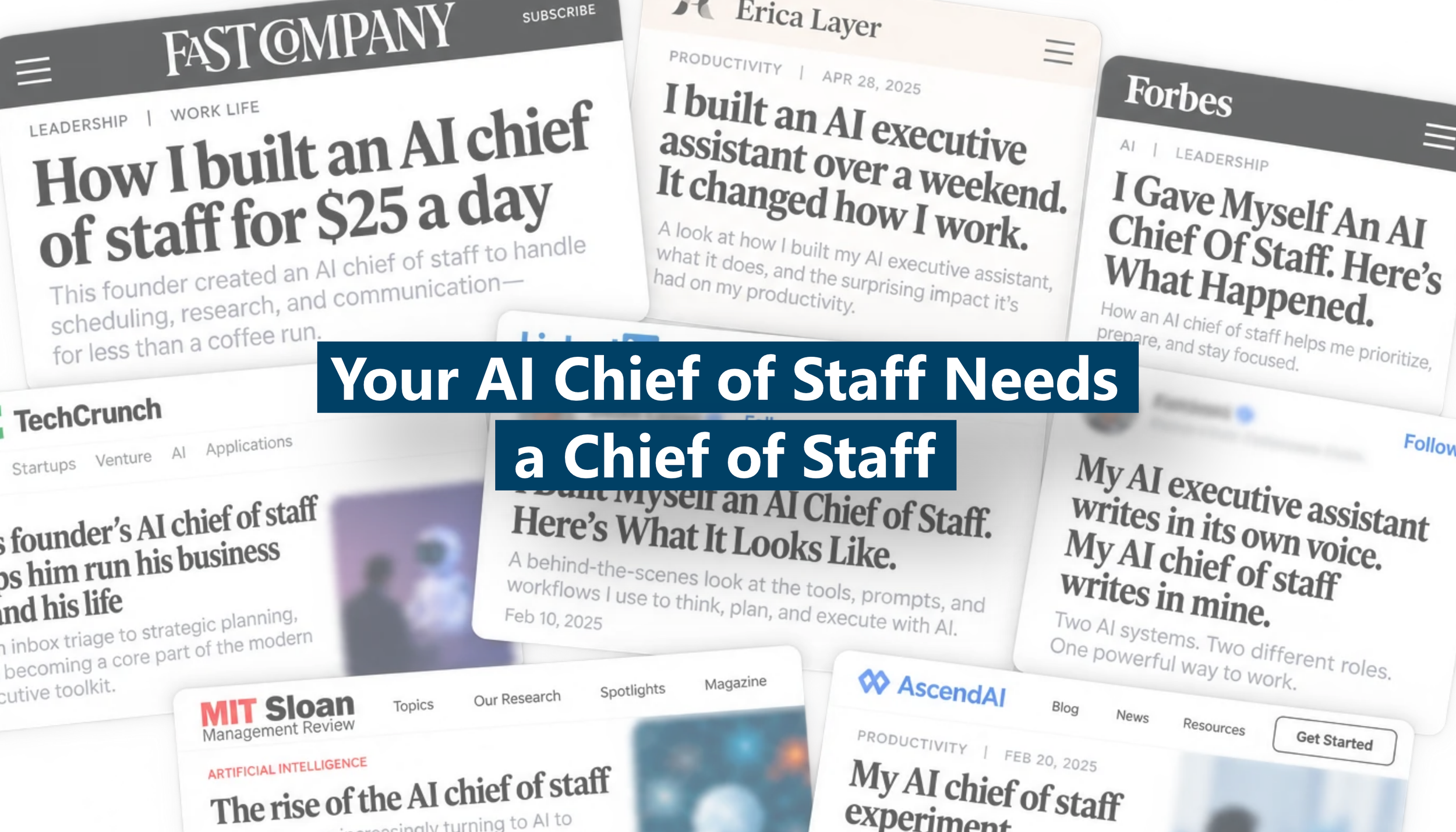
Every week I encounter another article or LinkedIn post introducing someone's new "AI Chief of Staff" or "AI Executive Assistant."
Usually, the author is celebrating that Copilot summarized an inbox, drafted a few emails, or generated a list of meeting action items.
Don’t get me wrong, these are useful capabilities. But calling a meeting summary prompt an automated Chief of Staff is a pretty extraordinary leap.
We've seen this story play out before, but this time we seem unusually eager to automate the ending.
Think back. When calculators and spreadsheets revolutionized accounting, we didn't start calling Excel our new CFO or tell the finance department to clean out their desks, right? We recognized that technology could make finance professionals dramatically more effective and helped them unlock the potential of the new technology.
Why, then, are so many people ready to declare Executive Assistants and Chiefs of Staff obsolete?
There are two fundamental problems with this line of thinking: it underestimates what effective executive support will require, even in an AI-enabled world, and it overlooks what AI could make possible in a well-supported C-Suite.
The Practical Problem: Who’s Going to Run Your AI Chief of Staff or Assistant?
Here's the first challenge: even the most sophisticated AI support system won't run itself indefinitely. Workflows break, integrations need maintenance, and executive priorities and preferences change.
The system will require ongoing attention to remain effective. The question is: who will be in charge of the upkeep?
If we assume it will be the executive, we’ve fallen into an uncomfortable trap. In an effort to protect the executive’s to-do list, we’ve actually added to it. And I have a hard time believing that this work will consistently get done.
When an automated workflow stops running, an executive may find time to troubleshoot it once or twice. But as competing priorities pile up, maintaining an AI support system is unlikely to rise to the top of the executive’s list. Over time, the automated workflows will be neglected, become less reliable, and eventually fall out of use altogether, leaving the executive with less support than they had before.
But let's assume the executive somehow finds the time for system upkeep. That brings us to the second problem: expertise.
While executive leaders excel at many of the same things across companies and industries, AI superuse is not yet one of those common competencies. A 2026 study of nearly 6,000 senior executives found that approximately 70% use AI for less than one hour per week. 28% don't use it at all. (1)
Automating support teams would require executives to become sophisticated AI operators and workflow architects practically overnight. You’d be betting the efficiency of the C-Suite on an elementary school student acing the SAT. That is not a smart play.
Ultimately, we're putting too much focus on the power of the AI platform and not enough attention on the proficiency (and availability) of the prompter.
The Strategic Problem: We’re Thinking Too Small
Let’s set those implementation challenges aside for now.
Imagine an executive really could replace their assistant with AI, eliminating a single salary while maintaining the same level of support.
Is that really the most exciting opportunity this era-defining technology presents?
It’s like witnessing the invention of air travel and celebrating because you can get to the grocery store faster. Sure, you've identified a possible use for an extraordinary invention, but you’re completely undervaluing its potential to transform your world.
We're so focused on whether AI can replace the person scheduling meetings that we've barely considered what that person could accomplish if scheduling meetings no longer consumed so much of their time.
The opportunity isn't simply to replace executive support, it's to fundamentally transform what executives and their support teams can accomplish together when leveraging AI effectively.
Perhaps the most compelling evidence of this potential comes from Anthropic, the company behind Claude.
In October, Anthropic posted a job opening for an Administrative Assistant role in their London office, paying roughly $191,000. The responsibilities included managing calendars, communications, travel, and other executive priorities for their senior leaders. (2)
That's right. One of the companies at the forefront of developing AI assistants is investing six figures in a human one.
Perhaps the people building the technology understand something the replacement headlines are missing: the future of executive support isn't necessarily human or AI. It's human and AI.
The Three Types of Work in an AI-Enabled Support Role
Here's what the replacement conversation keeps getting wrong: jobs aren't single tasks. They are collections of responsibilities, and AI will affect each one differently.
As AI becomes more capable, the work of Executive Assistants and Chiefs of Staff will increasingly fall into three categories.
Task Displacement: AI takes over this work
Some responsibilities will be substantially or entirely automated. Meeting transcription, routine data entry, information extraction, and certain administrative processes can already be handled with far less human involvement.
These tasks don't necessarily disappear, but responsibility for performing them shifts from the support team to AI.
Task Enhancement: AI makes this work easier or better
Other responsibilities will continue to require human involvement, but AI can dramatically reduce the time and effort required to complete them and, generally, produce a cleaner initial product.
Consider executive communication. AI can accelerate research, organize key messages, and create a strong first draft. A Chief of Staff then applies their understanding of the executive's voice, organizational context, and intended audience.
The ultimate responsibility remains with the human, but the work becomes faster, easier, and potentially better.
Human-Centered Work: These responsibilities remain primarily human
Finally, some responsibilities will continue to depend heavily on human judgment, relationships, discretion, and contextual understanding.
Navigating sensitive stakeholder relationships. Recognizing subtle shifts in executive priorities. Challenging an executive's decisions when necessary. Managing complex interpersonal dynamics.
AI may provide useful information or assistance, but these responsibilities remain fundamentally human-led.
The boundaries between displacement, enhancement, and human-centered work will continue to evolve as this technology advances. And while this way of thinking doesn’t rule out the fact that some positions may be eliminated, it does suggest that the more useful starting point is understanding how AI changes the work within a role, rather than assuming it should replace the role altogether.
What Could the Support Team Become?
Once we understand which responsibilities AI can take over or enhance, we can tackle a much more interesting question: What should Assistants and Chiefs of Staff do with the time they get back?
We see three main opportunities.
Opportunity #1: Make the Work More Sustainable
Executive support is demanding work, and many Assistants and Chiefs of Staff are already stretched thin. A 2024 survey by the National Association of Independent Schools found that 40% of executive and administrative support respondents felt they had too much to do or were being pulled in too many directions. (3)
Consider a Chief of Staff who is consistently operating at 125% of their capacity, working late and struggling to keep up with competing priorities. What if AI could bring that workload back down to 100% while maintaining the same volume of support for the executive and potentially improving its quality?
I’d call that a win-win.
Not every productivity gain needs to translate into more work. Sometimes the greater opportunity is making the existing work sustainable.
Opportunity #2: Expand the Breadth of Support
Imagine an Executive Assistant who is currently delivering excellent support across five domains: calendar management, inbox triage, travel support, meeting prep, and administrative support.
With AI handling or accelerating portions of that work, perhaps they can now deliver excellent support across eight domains, adding responsibilities like stakeholder engagement, executive communications, or project coordination.
The same support professional now has a broader impact.
Opportunity #3: Deepen the Sophistication of Support
Alternatively, support professionals could become substantially more effective within their existing responsibilities.
Calendar management could evolve beyond scheduling into the development of a defined executive time strategy, sophisticated time-allocation analyses, and proactive calendar audits.
Executive communications could expand from drafting individual messages to developing comprehensive communication plans tailored to different audiences.
The same areas of support - now with greater depth, quality, and strategic value.
Stop Trying to Eliminate the Support Team. Start Unlocking Its Potential.
For years, we've encouraged executives to stop spending valuable time on work their support teams could perform.
AI introduces the next evolution of that principle: support teams should stop spending their time on work that technology can reliably automate or accelerate.
The goal isn't to eliminate the human beings in the middle. It's to make the executive support system more capable and to push the entire group towards the important work that only they can do.
This evolution requires more than an AI license, however. It requires training, clear expectations, effective processes, and thoughtful coordination between executives and their support teams.
We can keep celebrating the fact that an AI assistant can summarize an inbox or we can start imagining what happens when talented executive assistants and chiefs of staff are equipped to accomplish substantially more than ever before.
Stop asking whether AI can replace your Executive Assistant or Chief of Staff. Start empowering them to use AI and see what the executive support system is really capable of.
Follow EES on LinkedIn, TikTok, and Instagram for insights on executive efficiency, support team effectiveness, and the future of performance enhancement in the C-Suite.
Citations
Bloom et al. (2026). Firm Data on AI. National Bureau of Economic Research. https://www.nber.org/papers/w34836
Anthropic (2026). Administrative Business Partner – London, UK. https://jobs.accel.com/companies/anthropic/jobs/58796953-administrative-business-partner-london-uk
National Association of Independent Schools (2024). Survey on Executive and Administrative Assistants. https://www.nais.org/resource-center/resources/research/nais-research-2024-survey-on-executive-and-administrative-assistants
